

The Scale of Displacement Has Quietly Become a Global Emergency That Demands Attention
Two years into Sudan’s civil war between the Sudanese Armed Forces and the Rapid Support Forces, a figure sits in the back of most international coverage without commanding the attention it deserves. Over 11 million Sudanese people have been displaced from their homes since April 2023. That makes Sudan home to the world’s largest internal displacement crisis. To put this in perspective, that number exceeds the entire population of Belgium. It rivals the pre-invasion population of Iraq. These are not statistics from complex data modeling or contested estimates. These numbers come from UNHCR tracking and represent actual human beings who have lost their homes, their livelihoods, and their sense of security. Yet somehow, this reality keeps getting buried under other news.

What strikes anyone who works in humanitarian response is not just the scale but the speed. The conflict escalated with shocking rapidity from a power struggle between two military factions into a catastrophe that has displaced more people than most active conflicts anywhere on Earth. The mechanics of displacement in Sudan follow patterns we have seen before, but the velocity has been staggering. Entire neighborhoods emptied in weeks. Communities that had existed for generations scattered across borders and into camps. Families separated not by years but by hours, with no clear path back to each other.
The Funding Gap Reveals How International Commitment Evaporates When Attention Fades
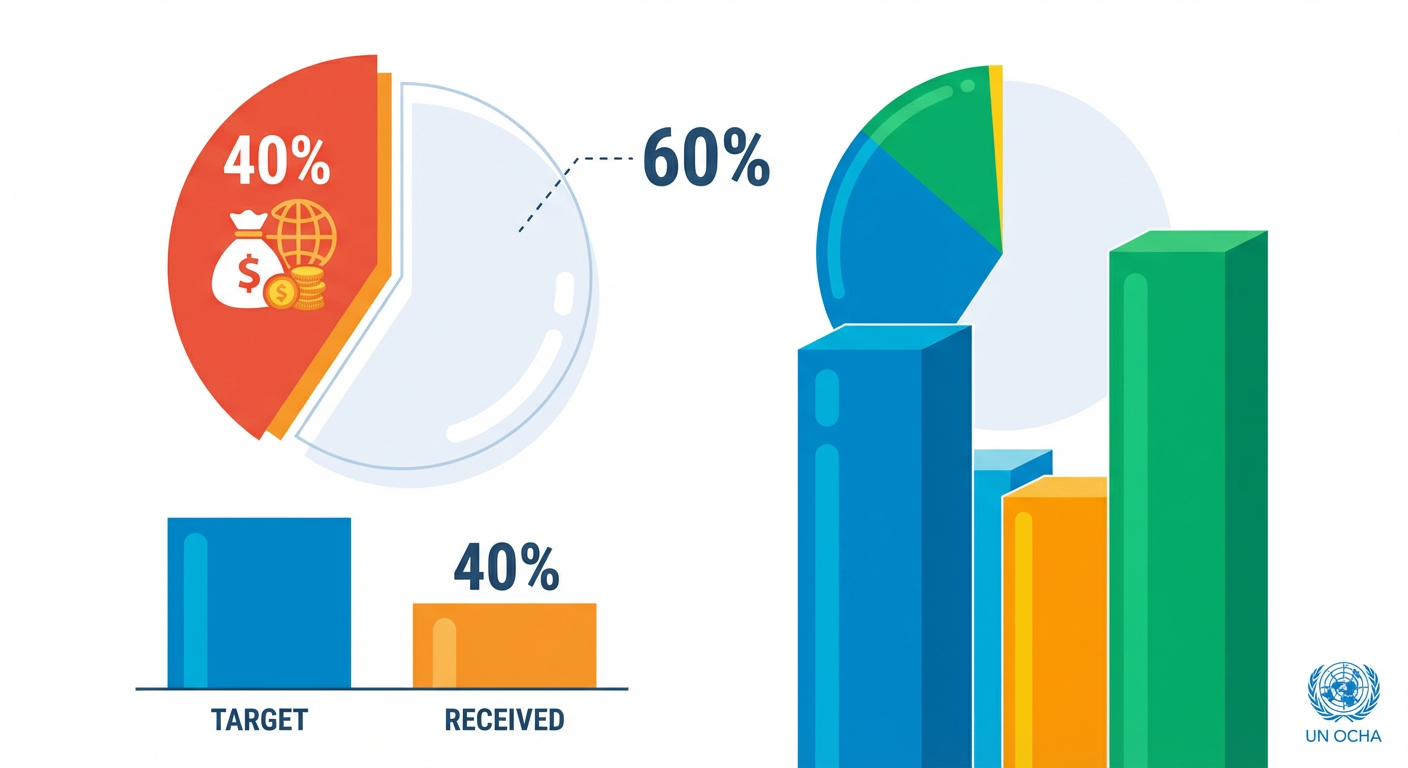
Follow the money, and you start to see where international priorities actually land. The UN Office for the Coordination of Humanitarian Affairs outlined a 2024 response plan for Sudan that required $2.7 billion to provide basic humanitarian assistance. As of early 2025, they had received approximately $1.4 billion. That is a 60 percent funding gap. Think about what that means practically. Medical clinics cannot operate at full capacity. Nutrition programs reach fewer children. Water and sanitation infrastructure gets built more slowly or not at all. The gap is not abstract. It translates into preventable suffering.
The funding shortfall exposes something uncomfortable about international humanitarian commitments. Organizations can sound urgent and concerned in public statements, but when it comes to actually transferring resources, political considerations and donor fatigue kick in. Sudan competes for attention with Ukraine, Gaza, and dozens of other crises, each one legitimate, each one deserving resources. The problem is that the international community has not built funding mechanisms that scale with actual need. Instead, we get a system where the most visible conflicts get resources while equally severe situations struggle. You can track this yourself by visiting UN OCHA Sudan Humanitarian Response Plan and comparing the funding percentages across different humanitarian appeals. The disparities are instructive.
The Security Council Deadlock Shows Why UN Reform Has Moved from Academic Exercise to Practical Necessity
Here is where the story gets directly political in a way that should concern anyone interested in how international institutions actually function. The UN Security Council attempted to pass a binding ceasefire resolution on Sudan in 2024. Russia abstained. China abstained or blocked. The resolution failed. This is not exceptional. The Security Council has struggled repeatedly to take substantive action on Sudan because the permanent members cannot agree. Russia and China have their own calculations about regional influence and relationships with various actors. Those calculations matter more to them than the humanitarian emergency unfolding on the ground.
This is not conspiracy thinking. It is straightforward political economy. Understanding why actors behave as they do does not require assuming hidden malice. It requires recognizing that the Security Council was designed to reflect the geopolitical interests of five powerful nations. When those interests diverge, or when other actors have leverage over those nations, binding action becomes nearly impossible. Sudan exposes this structural reality in a way that forces the question: can the UN function as originally designed, or does it need fundamental reform?
Famine and Atrocities Mark the Moment When International Failure Becomes Undeniable
In August 2024, the Integrated Food Security Phase Classification formally declared famine conditions in Zamzam displacement camp in North Darfur. This was not a prediction or a forecast of what might happen if conditions worsened. This was a declaration that famine was actually occurring. Zamzam camp held approximately 700,000 displaced people living in extraordinarily crowded conditions with limited humanitarian access. The famine declaration was the first globally since Somalia in 2022. That alone should have triggered urgent international mobilization. The response has not matched that threshold.
At the same time, the International Criminal Court issued an arrest warrant related to atrocities linked to the Sudanese Armed Forces in Darfur during 2024. The ICC has a mandate to prosecute mass atrocities, and it issued the warrant. But enforcement depends on state cooperation. States are supposed to arrest and transfer suspects to The Hague. That cooperation has not materialized. Sudan shows a pattern that repeats too often: international institutions with legitimate mandates hitting a wall when it comes to actual enforcement. You can review the humanitarian situation at UNHCR Sudan Emergency Situation Updates for detailed information.
What Reform Actually Looks Like Starts with Understanding What Broke
Sudan has become a case study for reform advocates because it demonstrates failures across multiple levels simultaneously. The Security Council cannot enforce a ceasefire. The humanitarian system cannot raise adequate funding. The ICC cannot enforce warrants. None of these failures happened in isolation. They happened together because they share the same underlying problem: international institutions designed for a different era are being asked to respond to contemporary crises with tools that do not match the job.
Real reform thinking about Sudan does not require naive idealism. It requires asking concrete questions about incentive structures. Why would China and Russia support a binding ceasefire resolution when regional considerations give them reasons to maintain ambiguity? Why would donor nations fully fund a Sudan response when domestic political pressures push them toward other priorities? Why would Sudan cooperate with ICC enforcement when doing so threatens the political positions of its military leadership? Once you ask these questions, you stop looking for villains and start looking for structural changes that would actually shift incentives.
If you are interested in how international institutions could work differently, Sudan is the place to focus your attention. Read the funding reports. Track the Security Council votes. Follow the humanitarian access restrictions. Look at where money actually goes. Real people’s survival is tied to whether international institutions reform or continue functioning along their current broken lines. What patterns do you notice when you dig into the details yourself?